Scotia Junction
The connection point that tied the unfinished Parry Sound Colonization Railway into a much larger railway story.
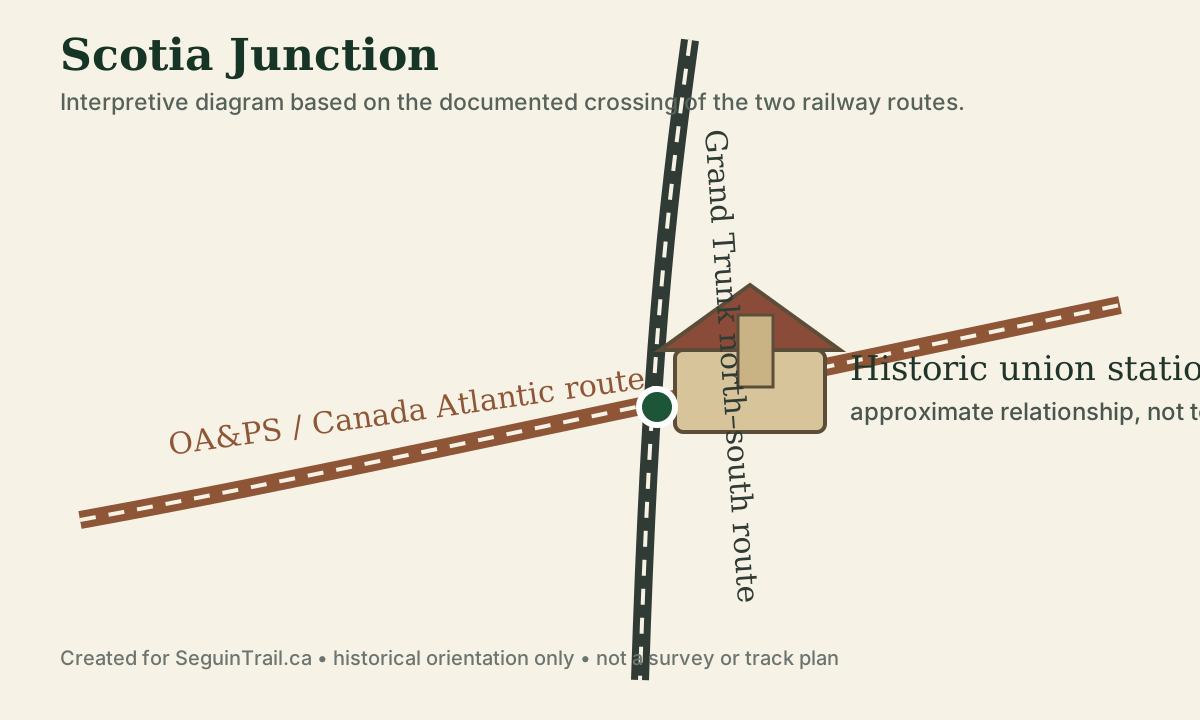
Scotia Junction is where the western history of the Ottawa, Arnprior & Parry Sound Railway begins to make sense. The Parry Sound Colonization Railway started building westward from this north-south railway connection in the 1880s. When that project ran out of money, J.R. Booth bought it and folded it into the much larger line he was driving across Ontario.
The western railway started here
The Parry Sound Colonization Railway was organized by Parry Sound interests that wanted a rail connection to the north-south railway. Construction began from the Scotia area in the 1880s and advanced westward, but the company never reached Parry Sound. It stalled around Bear Lake. Booth's 1892 acquisition of that unfinished line gave his project an existing western segment and a connection point at Scotia.
This is why Bear Lake and Scotia Junction belong in the same story: one marks the effective western end of the unfinished PSCR; the other marks its eastern connection to the established north-south railway.
A junction worthy of a distinctive station
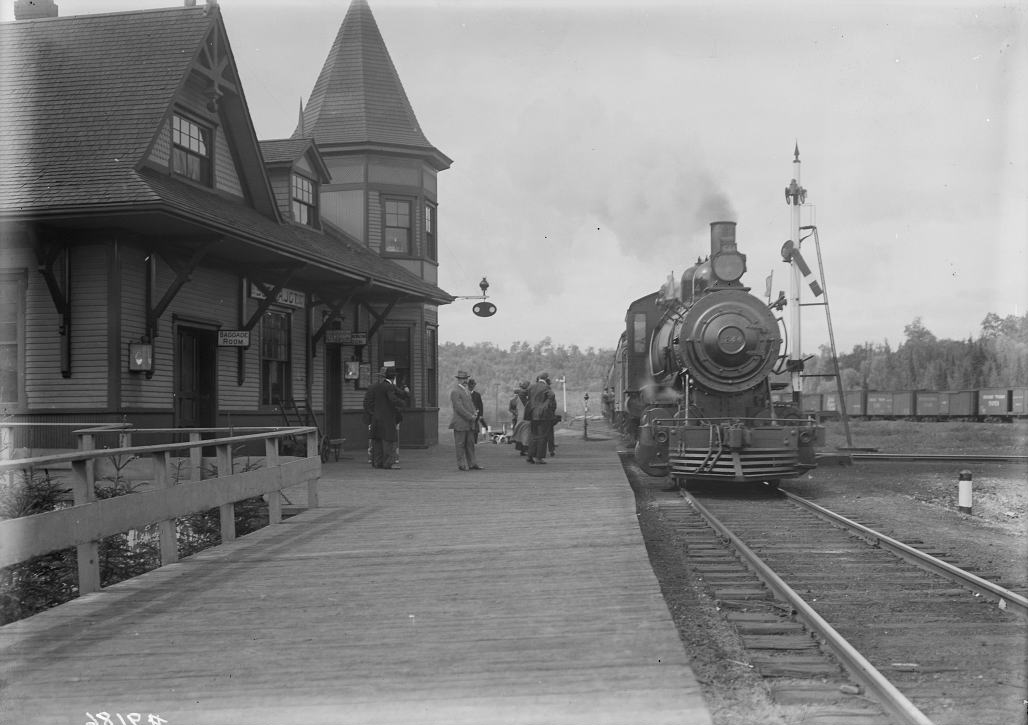
Railway-station research describes a substantial union station built in the late 1890s, with a prominent tower positioned to serve the crossing lines. Historic photographs show the junction as a busy railway place rather than the quiet rural landscape a visitor encounters today.
The replacement station can now be tied directly to surviving Grand Trunk architectural records. Library and Archives Canada lists Item 566, dated June 1917, as plans, sections and elevations for a new station at Scotia Junction, and Item 567, dated August 1917, as millwork details for the same project. Secondary station histories disagree on whether the earlier station fire occurred in 1914 or 1917, so this site does not force a precise fire date; the archival drawings establish that the replacement station was being designed in 1917.
Primary-source station drawings
The 1917 plans are especially valuable because they may let us reconstruct the replacement station from measured elevations rather than from photographs alone. The next archival step is to obtain usable copies of Items 566 and 567.
West Parry Sound District Museum — OA&PS model railway
The Museum on Tower Hill in Parry Sound displays Graham MacDonald’s large model of the OA&PS Western Division. Built over 17 years, the model represents the railway around 1922/23 from Madawaska to Depot Harbour. The donor also transferred his research material to the museum, making it especially relevant to anyone following this corridor.
Location: 17 George Street, Parry Sound. Current details: hours and admission can change, so check the museum before travelling.
A photograph brings the junction back to life
The William James view above puts a steam locomotive, passengers and railway staff directly beside the station. The next archival step is to pair this photograph with primary railway plans and a present-day field view so the station, track arrangement and modern landscape can be compared side-by-side.
Decline of the junction
The east-west line lost through importance after failures and closures farther east in Algonquin Park, and the old Booth route was eventually abandoned through this area. The north-south railway survived, but the elaborate junction infrastructure did not. That makes Scotia an excellent candidate for a “then and now” field survey: old station photographs can be compared against the modern crossing landscape, even if little built fabric remains.
Do you have another Scotia Junction photograph?
The ca. 1910 station photograph gives us an excellent historical anchor. Additional historic views, family photographs or present-day images from the junction would help build a stronger then-and-now record. Contributions are moderated before publication.
Sources & further research
- Library and Archives Canada, Grand Trunk architectural drawings finding aid: Item 566, new Scotia Junction station plans, sections and elevations, June 1917; Item 567, millwork details, August 1917.
- William James, Scotia Junction GTR station, ca. 1910; City of Toronto Archives, Fonds 1244; digital copy via Toronto History / Wikimedia Commons. Source record.
- Ontario railway-station research for station chronology, junction role and architectural descriptions. Secondary sources disagree on the exact year of the first station fire; the 1917 LAC drawings provide the firm date for the replacement design.
- West Parry Sound District Museum, E. Roy Smith Gallery: Graham MacDonald OA&PS model railway and donated research collection.
- Parry Sound Colonization Railway records and secondary railway histories for the Booth acquisition and Bear Lake construction limit.