Depot Harbour
The western terminal, grain elevators, company town and Great Lakes connection.
Explore Depot Harbour →Lumber, railways, grain, Great Lakes shipping — and the industrial system behind today’s Seguin Trail.
John Rudolphus Booth (1827–1925) is the central figure behind the railway corridor that became the Seguin Trail. His lumber empire needed faster, year-round transportation; his railway ambitions reached from the Ottawa Valley to Georgian Bay; and the harbour, stations, cuts, fills, bridges and abandoned grade left behind by that system still shape the landscape explored on this site.
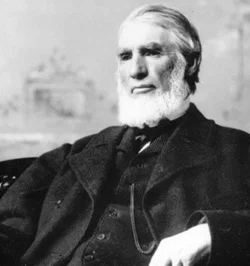
Booth lived almost a century and worked through several transformations of the Canadian forest economy: square timber, large-scale sawmilling, railway building, grain transportation, Great Lakes shipping and eventually pulp and paper. The OA&PS was not a side project. It was part of an integrated transportation system designed to connect resources, mills and markets.
Booth was born near Waterloo in Lower Canada in 1827. As a young man he worked as a carpenter and gained railway experience on bridge work for the Central Vermont. He moved to the Ottawa area in the 1850s and entered the lumber trade at the Chaudière. A decisive early success came in 1859 when he won a contract to supply lumber and timber for the new Parliament Buildings.
That contract provided capital and credibility, but the larger transformation came from acquiring timber limits. In 1867 Booth purchased valuable Madawaska limits, and during later downturns he continued buying forest rights. His holdings eventually covered roughly 640,000 acres across a vast part of the Ottawa watershed. The Dictionary of Canadian Biography records his lumber output rising from about 30 million board feet in 1872 to about 140 million in 1892; in 1896 his output still exceeded that of any other major Ottawa Valley firm by a wide margin.
Booth’s business depended on water. Rivers were excellent highways for logs, but they froze, did not run everywhere he needed them, and were slow or awkward for finished lumber headed to distant markets. Railways offered three things his lumber operation badly wanted: lower labour costs on some movements, freedom from the shipping season, and speed.
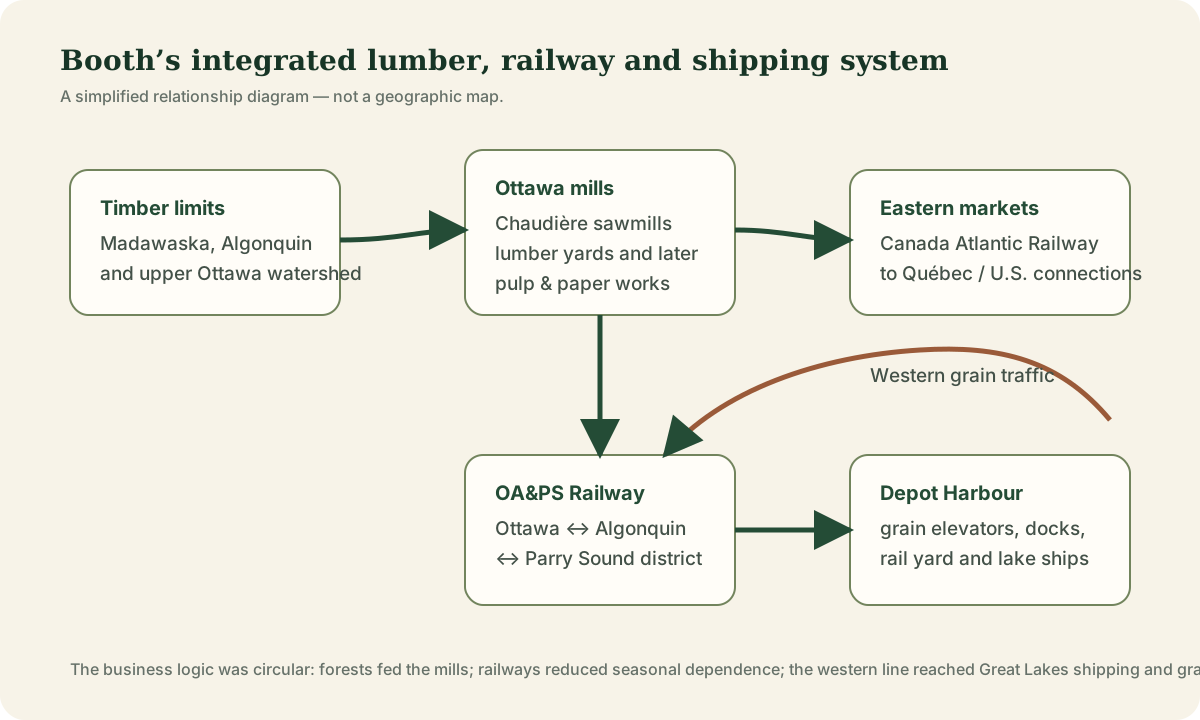
Booth became deeply involved in the Canada Atlantic Railway in the late 1870s after the original promoters struggled to complete it. By 1882 the line linked Ottawa with Coteau on the St. Lawrence, ultimately connecting with routes toward Vermont and northeastern U.S. markets. That railway gave his Ottawa mills a dependable outlet for lumber and taught Booth how powerful a privately controlled transportation system could be.
He also built the short Nosbonsing & Nipissing Railway in the 1880s to move timber between watersheds. It was a small line compared with the OA&PS, but it demonstrated the same idea: use rail to bridge the places where rivers and lakes did not provide the connection his lumber operations needed.
Booth had contemplated a westward railway as early as the 1880s. The Ottawa, Arnprior and Renfrew Railway and the Ottawa and Parry Sound Railway were chartered in 1888 and combined in 1891 as the Ottawa, Arnprior & Parry Sound Railway. Construction then pushed west in stages between 1892 and 1896.
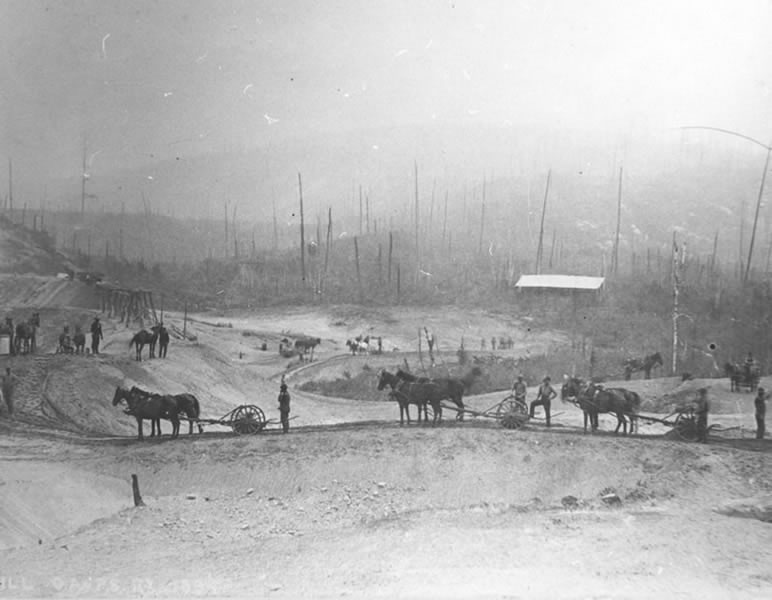
The first survey itself hints at the difficulty. A 24-man party under engineer George Mountain left Ottawa in November 1891 and returned in March 1892 after surveying about 120 miles and travelling more than 500 miles through rough, sparsely settled country. The final railway had to cross rock ridges, swamps, river valleys and the high interior terrain of what became Algonquin Provincial Park. Cuts, fills, trestles and carefully maintained grades were therefore fundamental parts of the route, not incidental features.
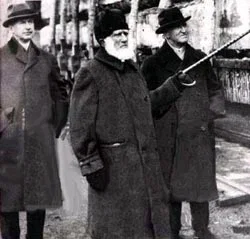
A contemporary newspaper account later preserved in railway research attributes a characteristic remark to Booth: when told trains might manage 40 miles per hour, he reportedly replied that they would go 60 or he had no use for them. Whether or not the wording is exact, the anecdote fits a railway that was built as a serious through route rather than a temporary logging tramway.
Lumber alone was not enough to justify a railway of this scale. Booth wanted through traffic. A western terminal on Georgian Bay could connect Great Lakes shipping with his rail system and create a shorter route for western grain and other freight moving toward Montreal and eastern markets.
That logic produced Depot Harbour, the company town and transfer terminal on Parry Island. Grain elevators, freight sheds, wharves, a roundhouse, yard tracks and lake steamers turned the harbour into the western gateway of Booth’s system. Dominion records show more than twelve million bushels handled in 1899 and more than thirteen million in 1900. The railway was therefore carrying a great deal more than timber.
Through freight reached Depot Harbour in 1896, and the first through passenger service followed that December. During busy navigation seasons the line could be intensely active. Period reports describe heavy eastbound grain traffic and multiple freight trains moving across a corridor that today can seem extraordinarily quiet.
The western terminal, grain elevators, company town and Great Lakes connection.
Explore Depot Harbour →Grain totals, equipment, passenger schedules and the operating side of the railway.
See trains and traffic →Follow the stations and lost railway names between Depot Harbour and Scotia Junction.
Follow the line →The OA&PS crossed the southern part of the newly created Algonquin Park. For Booth, the route gave year-round access to forest limits and a way to move supplies and products. The railway later helped turn Algonquin into a tourist destination as passenger trains, hotels and railway promotion made the interior far easier to reach.
The same story also has a harder side. Booth’s enterprises were part of a broader era of colonial resource extraction. The railway terminus at Depot Harbour was established on Parry Island, within Indigenous land, using legislation that allowed railway interests to acquire land for construction. The development changed the landscape and affected the community now known as Wasauksing First Nation. A complete history of Booth’s achievement has to include both the remarkable industrial system he built and the human and environmental costs associated with that expansion.
Booth’s reputation for efficiency and personal control was formidable. Contemporary and later accounts describe a highly centralized, autocratic management style. His mills employed large workforces but labour relations were not easy: in 1891 Booth and other Chaudière mill owners faced a major strike over low wages and eleven- or twelve-hour working days.
The scale of the lumber business also created environmental problems familiar to nineteenth-century resource industries. Sawdust and mill waste affected waterways, while fires repeatedly threatened the mills, yards and neighbouring districts. Booth’s operations suffered serious fires in the 1890s, the great Hull–Ottawa fire of 1900, and later lumber-yard fires. He repeatedly rebuilt.
In 1899 the OA&PS was formally amalgamated into the Canada Atlantic Railway. By then Booth controlled a large integrated system of railways and shipping interests often called the “Booth Group.” In 1904 he sold the Canada Atlantic properties to the Grand Trunk Railway for $14 million and became a Grand Trunk director. The former Booth lines subsequently passed into the Canadian National system.
The sale did not end Booth’s industrial career. In his late seventies he invested heavily in pulp and paper at Ottawa. The last great raft of squared timber handled by his organization went down the river in 1908, a symbolic marker of the transition from the older timber trade to newer forest industries.
Booth remained active into extraordinary old age. He reorganized his sole proprietorship as John R. Booth Limited only in 1921, when he was in his nineties. He died in Ottawa on 8 December 1925 at age 98. His estate was officially valued at nearly $7.7 million.
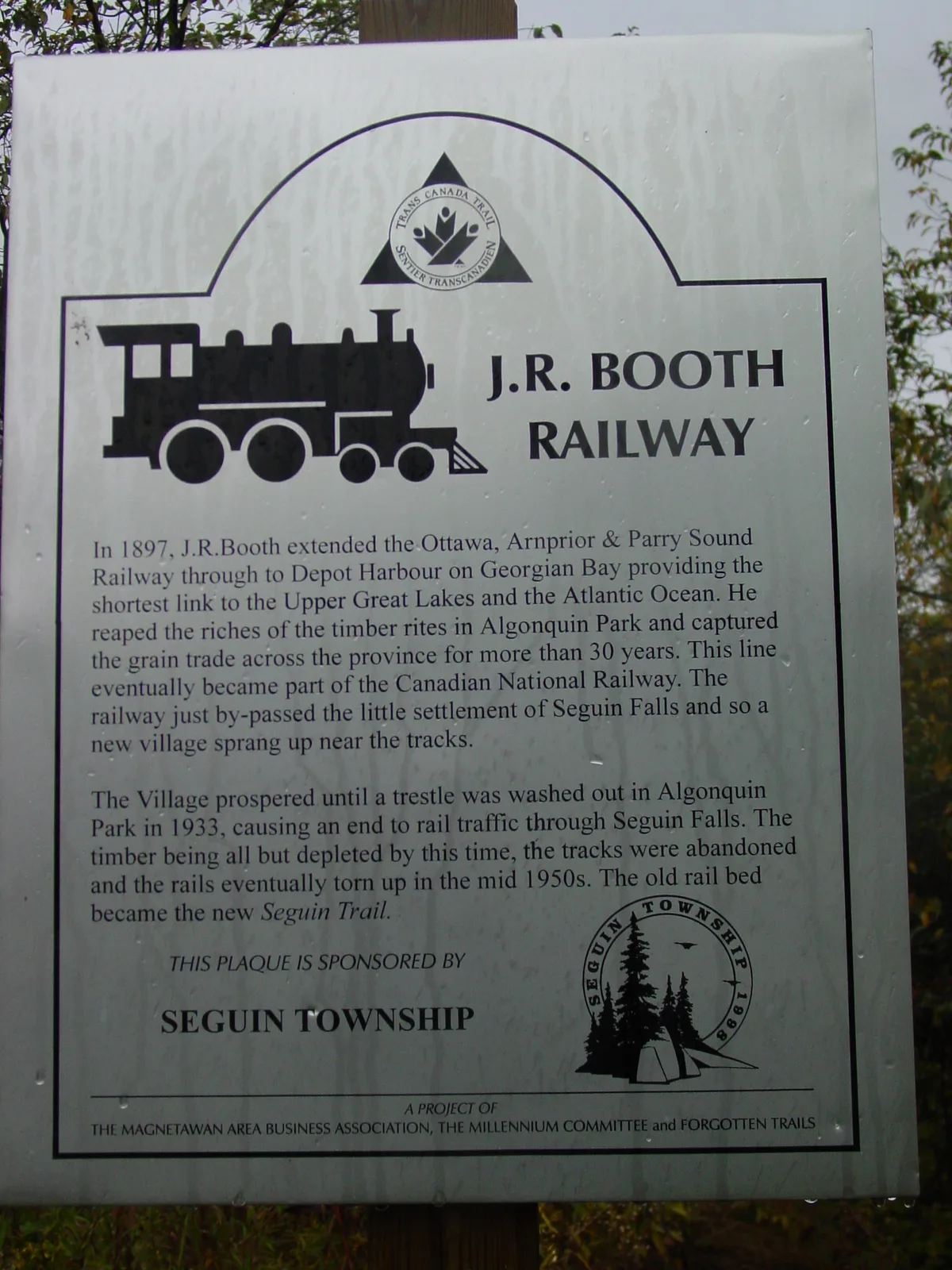
For someone standing today on the Seguin Trail, Booth’s legacy is unusually tangible. The trail is not simply near his railway; in many places it is his railway grade. Rock cuts, embankments, bridge abutments, station clearings and old settlement patterns all derive from decisions made while trying to move timber, grain, passengers and freight across Ontario.
The places explored elsewhere on this site — Rose Point, Swords / Maple Lake, Seguin Falls, Bear Lake, Scotia Junction and dozens of smaller railway names — make more sense when seen as parts of Booth’s integrated system rather than isolated historic curiosities.
John Rudolphus Booth is born near Waterloo, Lower Canada.
Wins the contract to supply lumber and timber for the new Parliament Buildings in Ottawa.
Acquires important Madawaska timber limits, helping establish the resource base for his expanding lumber empire.
Becomes a driving force behind the Canada Atlantic Railway and completes the Ottawa–Coteau connection.
Builds the Nosbonsing & Nipissing Railway to bridge two watersheds used by his timber operations.
The OA&PS is organized, surveyed and built westward across the Canadian Shield to Georgian Bay.
Through freight and passenger service reach Depot Harbour.
The OA&PS is amalgamated into the Canada Atlantic Railway; Depot Harbour is already handling immense volumes of grain.
Booth sells the Canada Atlantic system to the Grand Trunk Railway for $14 million.
The last major Booth squared-timber raft marks the fading of the older timber era.
Booth dies in Ottawa at age 98.